Oct 19, 2026 · Florico design
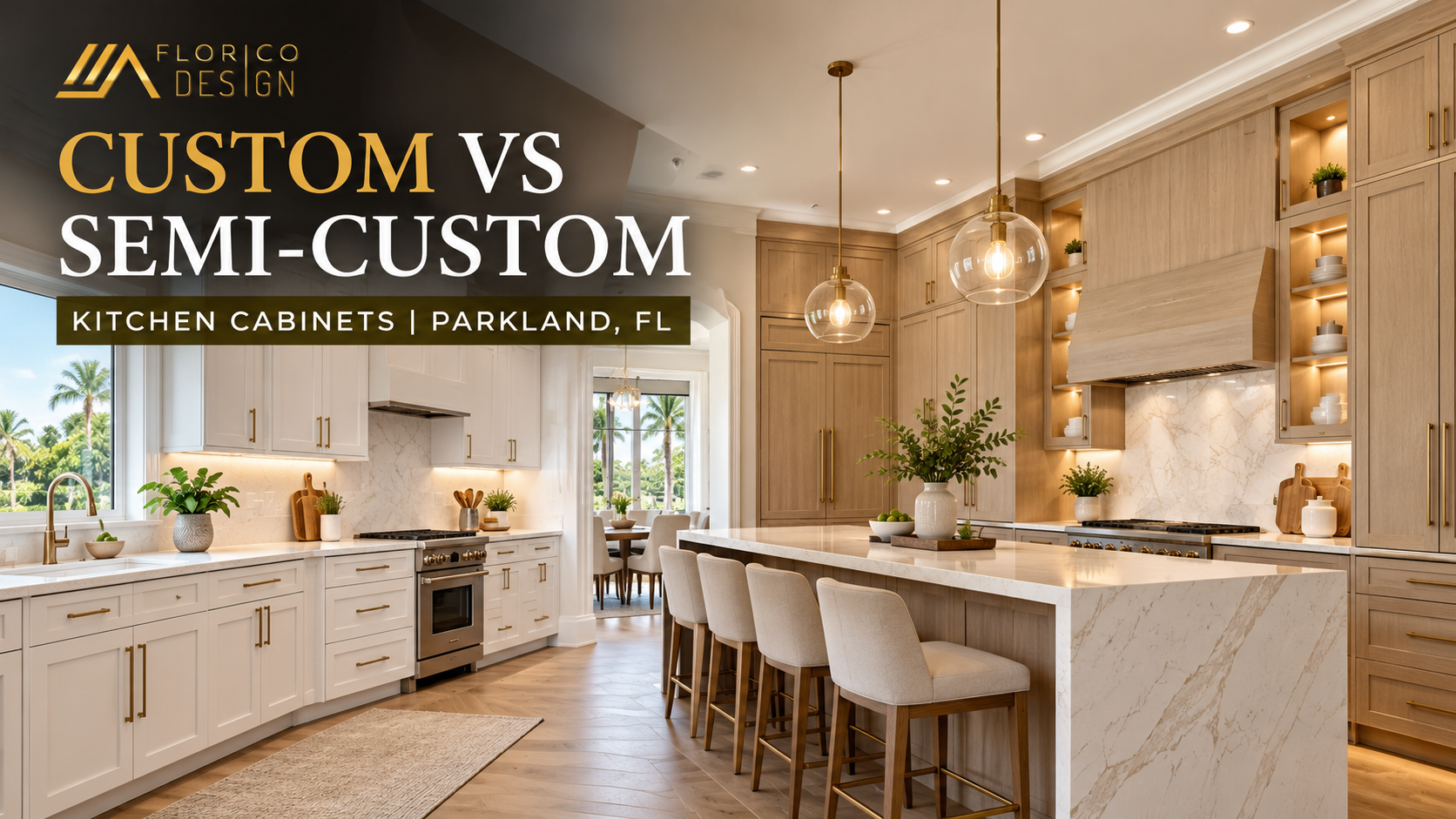
Custom vs. Semi-Custom Kitchen Cabinets: Which Is the Better Choice for Florida Homeowners in 2026?
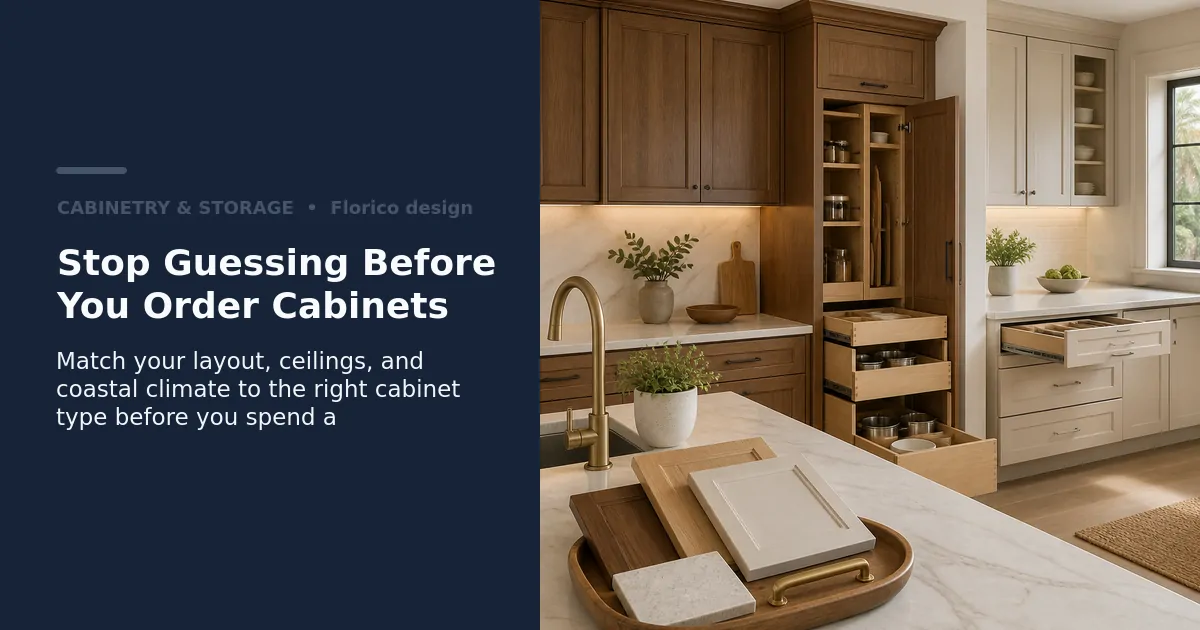
For many Florida homeowners in 2026, semi-custom cabinets are the better value — unless your kitchen has non-standard dimensions, unusually tall ceilings, or storage needs that stock sizing can't solve, in which case full custom wins. The deciding factor is rarely style; it's geometry, lead time, and how the cabinet box and finish hold up in a humid, salt-air climate. The fastest, lowest-cost way to settle it: write down your wall measurements and ceiling height, then review [kitchen cabinets](https://floricodesign.com/kitchen-cabinets) with a designer against your actual layout. That one conversation usually tells you whether custom work would buy you a better fit or just a bigger invoice — before you commit to anything.
## The Short Answer for Florida Homeowners
Choose **semi-custom** if your kitchen has rectangular walls, 8- or 9-foot ceilings, standard appliance sizes, and storage frustrations that a catalog accessory can solve. In that situation, semi-custom will provide nearly all the design freedom for less money and a shorter, more predictable timeline.
Choose **custom** if any one of these is true: you have angled or curved walls, structural columns, a 10-foot-plus ceiling you want cabinetry to reach in one uninterrupted run, an alcove or appliance that doesn't land on a standard increment, or a storage need no catalog covers.
Choose a **hybrid** — semi-custom runs with a few custom pieces — when only one or two areas of the kitchen are the problem.
Quality is not what separates the two categories. A well-specified semi-custom cabinet routinely outperforms a budget custom one, so the decision between them should come down to fit, timing, and how much specificity you actually need.
## What "Custom" and "Semi-Custom" Actually Mean
These terms get used loosely, so define them before you price anything. Most of the confusion around custom vs semi-custom kitchen cabinets comes from treating the two as quality tiers rather than as two different ways of ordering the same product.
**Semi-custom cabinets** are built from a manufacturer's established catalog of cabinet boxes, typically in fixed width increments (commonly 3 inches), with a wide menu of door styles, finishes, interior accessories, and modifications like reduced depth or increased height. You're configuring a system, not designing from scratch.
**Custom cabinets** are built to your specific dimensions. Width, depth, height, interior divisions, and construction details are specified per cabinet. There's no increment limit, and the shop can accommodate angles, curves, appliance panels, and unusual materials.
**Stock cabinets**, for reference, are pre-built in fixed sizes with limited finish options. They're the fastest and least expensive, but they're a different conversation — remodels that involve moving plumbing or replacing countertops often end up in semi-custom or custom territory.
The practical difference is flexibility versus predictability. Semi-custom gives you most of the design freedom with a defined process. Custom gives you complete freedom and a longer, more hands-on process.
## Five Decision Criteria for Florida Kitchens
### 1. Your Floor Plan's Geometry
Measure your kitchen walls and note any obstacles: soffits, angled corners, bump-outs for plumbing stacks, low windows, or columns.
If your runs break down cleanly into standard increments with filler strips of 3 inches or less, semi-custom will fit well. If you'd need 6-inch-plus fillers in multiple spots, or you have an angled wall, custom usually produces a cleaner result for a comparable amount of design effort.
Condo kitchens are a frequent custom case when they include load-bearing columns, tight galley widths, or ducting that forces non-rectangular cabinetry.
### 2. Ceiling Height
If your ceilings are 9 or 10 feet — or higher, as in some newer construction — taking uppers to the ceiling eliminates the dust shelf and adds real storage.
Many semi-custom lines offer 42-inch and sometimes 48-inch wall cabinets, plus stacked upper configurations. Pairing 42-inch wall cabinets with a 9-foot ceiling and crown molding is a straightforward solution that stays comfortably inside catalog territory. If you have a 10-foot ceiling and want a single uninterrupted door face from counter to crown, that's custom work.
### 3. Humidity and Coastal Air
This is where Florida diverges from national cabinet advice. Year-round humidity, salt air near the coast, and air conditioning cycling create conditions that expose weak construction.
When you're choosing kitchen cabinets for humid climates, these specifications matter more than custom-versus-semi-custom:
- **Box material.** Plywood boxes generally handle moisture swings better than particleboard. Many semi-custom lines offer plywood as an upgrade — ask for it specifically.
- **Door and frame material.** Solid wood expands and contracts with humidity, and painted solid wood can show hairline joint lines at the stile-and-rail seams over time. That's wood behaving normally, not a defect. MDF center panels or full MDF doors are more dimensionally stable for painted finishes.
- **Finish quality.** A catalyzed conversion varnish or factory-applied finish generally holds up better than a site-applied finish in humid conditions.
- **Hardware.** Soft-close hinges and undermount slides from established manufacturers resist corrosion better than unbranded hardware.
These specifications are available in both categories, so construction quality is a separate decision from custom versus semi-custom. "Custom" is not a quality grade.
### 4. Timeline
Semi-custom lead times are generally shorter and more predictable because the manufacturer runs production in batches. Custom shops build each job sequentially.
If you're coordinating around a seasonal rental window, a closing date, or snowbird season, predictability has real value. Ask any supplier for a current lead time in writing before you commit — lead times shift with material availability and are worth re-confirming in 2026 rather than assuming last year's numbers.
### 5. Storage Specificity
List what actually frustrates you about your current kitchen: no place for sheet pans, a corner that swallows pots, no pantry, no spot for small appliances, no tray dividers.
Semi-custom catalogs include most of these solutions — pull-out trash, roll-out trays, spice pull-outs, tray dividers, corner solutions, drawer organizers. If your list is covered by the catalog, you don't need custom.
Custom becomes worthwhile when the need is genuinely unusual: an appliance garage sized to a specific coffee setup, a banquette with integrated storage, a pet feeding station built into a toe kick, or cabinetry designed around a collection.
## Cost Tradeoffs Without the Guesswork
Prices vary by material, finish, door style, hardware, and shop, so treat any blanket figure for custom kitchen cabinets cost with suspicion. The reliable generalization is ordering: stock is least expensive, semi-custom sits in the middle, full custom is highest — and each step up expands both options and lead time.
Where budgets usually get strained is not the base cabinet but the add-ons: specialty finishes, glass doors, integrated appliance panels, interior organizers in every cabinet, and decorative end panels. These accumulate quickly in both categories.
A sensible approach is to allocate dollars by visibility and use:
- Spend on the perimeter run you see from the living area and on the drawers you open daily.
- Economize on the inside of a pantry or a laundry-adjacent run.
- Choose plywood boxes in the sink base and dishwasher-adjacent cabinets at minimum.
Because cabinets and counters are ordered and templated together, confirm your [countertops](https://floricodesign.com/countertops) selection early — overhangs, sink type, and edge profile all affect cabinet specification, and changing stone after cabinet ordering can create fit problems.
If budget timing is the obstacle rather than budget size, consider asking about [finance](https://floricodesign.com/finance) options before you downgrade materials you'll live with for a decade.
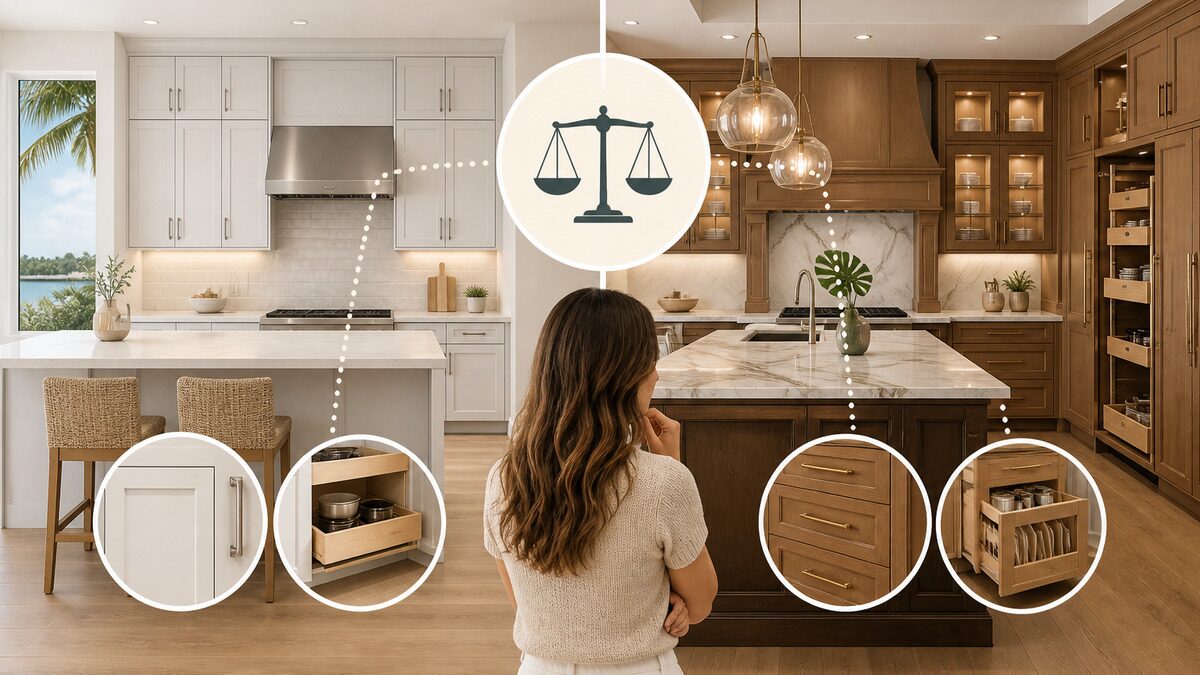
## The Hybrid Approach Most People Overlook
You don't have to choose one path for the entire kitchen. A practical middle route is semi-custom for the standard runs plus a small number of custom pieces for the problem areas — an island, a hood surround, a bank of cabinets on an angled wall, or a tall unit sized to an exact alcove.
This works best when both the semi-custom line and the custom pieces use the same door style and finish, and when one designer coordinates finish matching. Painted finishes match more reliably across sources than stains, which vary with wood grain. Looking at completed kitchens in a [gallery](https://floricodesign.com/gallery) is useful here, because hybrid work is hard to describe and easy to recognize.
## A Hypothetical Walk-Through
*The following is a made-up scenario for illustration, not a real customer project.*
Imagine an L-shaped kitchen with 9-foot ceilings, a soffit above the uppers, standard rectangular walls, and appliances staying where they are. Running the criteria: the geometry needs no angled boxes, a 42-inch upper plus crown closes the gap once the soffit comes out, and the wish list — pantry, trash pull-out, tray dividers, deep pot drawers — is all catalog. **Decision: semi-custom**, with the savings reallocated to plywood boxes, MDF-panel painted doors, a factory finish, and better hardware.
Now change one variable: add a 20-degree angled wall where the kitchen meets a Florida room, plus a 10-foot ceiling. Standard boxes would require awkward fillers at the angle and a dead zone above the uppers. **Decision: custom, or a hybrid** that uses custom only on that wall.
## Common Mistakes to Avoid
1. **Shopping door styles before measuring.** Measurements determine which path is even viable; style is the last decision.
2. **Assuming custom means better quality.** Ask about box material, joinery, drawer box construction, hinge and slide brand, and finish type regardless of category.
3. **Skipping plywood in wet zones.** The sink base is the cabinet most likely to see moisture. This is not the place to economize.
4. **Locking in cabinets before appliances.** Appliance dimensions, door swing, and panel-ready requirements all change cabinet specs. Buy or at least spec appliances first.
5. **Forgetting HOA and condo rules.** Many associations have rules on work hours, elevator use, and permits. Confirm these before scheduling delivery.
6. **No plan for the floor transition.** If flooring is also being replaced, decide the order of operations early so toe kicks and appliance heights work out.
## How to Decide in One Sitting
1. Measure every wall, ceiling height, and obstruction, including window sill heights.
2. Photograph the kitchen from three corners.
3. Write down your top five storage frustrations.
4. Confirm or select appliances and note their dimensions.
5. Check whether a standard-increment layout leaves fillers larger than 3 inches anywhere.
6. Set a target installation window and work backward through lead time.
7. Bring all of the above to a designer and ask for both a semi-custom and a custom-or-hybrid version of the same plan.
Seeing the same kitchen drawn two ways, with the same door style and finish on both, makes the tradeoff concrete: you can see exactly where the extra money buys a better fit and where it buys nothing. Often the two drawings differ on only one wall — and that's the moment the hybrid option starts to make sense.
## Frequently Asked Questions
### How do I compare a custom quote and a semi-custom quote fairly?
Ask for the same layout priced both ways with identical specifications — same box material, same door style, same hinges and slides, same accessories — so you're seeing the real delta on your kitchen instead of a generic percentage. Then check what each quote includes beyond the boxes: delivery, freight, fillers, scribe and finished end panels, toe kick, crown, installation, and disposal are handled differently from supplier to supplier, and those line items can move the comparison more than the cabinets themselves.
### What happens if a cabinet arrives damaged or doesn't fit during installation?
With semi-custom, a replacement box, door, or drawer front is a reorder from an existing catalog line, which usually makes the fix routine — though you're still waiting on the manufacturer's current lead time for that part. With custom, the shop that built the piece has to build it again, so the fix depends on that shop's schedule. Either way, ask before ordering how replacement parts and small on-site adjustments are handled, and have the delivery inspected before the installer is scheduled.
### Can I add or replace matching cabinets years later?
Plan as if you can't. Manufacturers discontinue door styles and reformulate finishes over time, and a custom shop may change hands or close, so an exact match years out isn't guaranteed in either category. Two practical hedges: keep a written record of the line, door style, finish name or code, and hardware model, and ask whether you can keep a spare door or a finished sample for future color matching.
### Do I need custom cabinets for panel-ready appliances or an integrated hood?
Not necessarily. Many semi-custom lines offer appliance panels, matching toe-kick and filler material, and hood mantels or chimney surrounds as catalog items. The test is whether the line's available panel sizes and reveals match the appliance manufacturer's specification sheet for your exact model. If they don't — or if the appliance needs an unusual trim detail — that single element is a common candidate for a custom piece inside an otherwise semi-custom kitchen.
## The Bottom Line
The custom vs semi-custom kitchen cabinets decision isn't a quality contest; it's a fit contest. Semi-custom is the better choice for many Florida kitchens because it provides the overwhelming majority of the design options with a shorter, more predictable lead time, leaving room in the budget for the specifications that actually matter in this climate — plywood boxes, stable door materials, and a factory finish. Custom earns its premium when the room itself refuses to cooperate: angles, columns, tall ceilings, odd alcoves, or storage that no catalog covers. When only part of the kitchen is the problem, a hybrid gives you both. Measure first, spec the construction second, and let the drawings — not the door samples — tell you which path is right.