
Oct 12, 2026 · Florico design
How to Choose Flooring for Parkland Homes: Waterproof Options That Handle South Florida Humidity
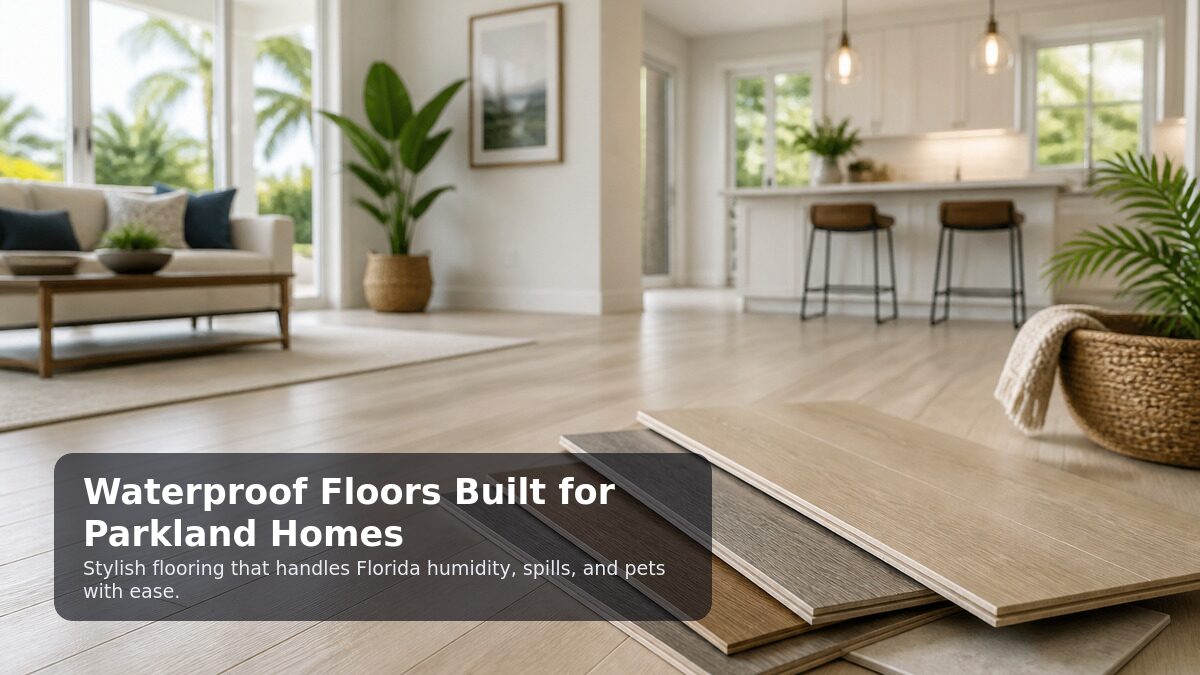
If you live in Parkland, your floors fight a quiet battle every day: indoor humidity swings, afternoon downpours, wet feet from the pool, and a slab that never fully dries out. The short answer on what survives it: porcelain tile (including wood-look planks), rigid-core luxury vinyl, engineered hardwood installed over a tested and mitigated slab, and polished or micro-topped concrete — with carpet reserved for dry bedrooms and upstairs rooms. Each can look like white oak or Italian stone while shrugging off moisture, and the right [products](https://floricodesign.com/products) make the choice easier. This guide explains how to evaluate those materials, what installers here get wrong, and how to decide before you spend a dollar.
## The Short Answer: What Actually Holds Up Here
Four materials make the shortlist for waterproof flooring Parkland FL homes need, and which one wins depends on the room:
- **Porcelain tile, including wood-look planks** — the most moisture-proof and heat-tolerant of the group. Best anywhere near pool entries, sliders, bathrooms, and laundry rooms.
- **Rigid-core luxury vinyl (SPC/WPC)** — waterproof top to bottom, warmer and quieter underfoot than tile, and more forgiving over a slightly uneven slab.
- **Engineered hardwood over a tested, mitigated slab** — the only way to get real wood here, and it's moisture-*tolerant* rather than waterproof, so it stays out of wet rooms.
- **Polished or micro-topped concrete** — stable in humidity, already sitting under your house, and a natural fit for modern coastal interiors.
Carpet and rugs still earn a place in dry bedrooms, media rooms, and upstairs spaces — just never near water. The sections below explain why these four survive local conditions, how to match each one to a room, and which installation details decide whether any of them lasts.
## Why South Florida Humidity Changes the Flooring Equation
In most of the country, flooring fails from wear. In Broward County, it fails from moisture. Relative humidity here regularly sits between 70% and 90%, and most Parkland homes are built on concrete slabs that transmit vapor upward year-round. Add hurricane-season pressure swings and an AC system that cycles aggressively, and you get three classic failures: cupping and gapping in solid wood, edge swelling in cheap laminate, and adhesive breakdown under glue-down planks.
That's why choosing floor coverings for Parkland properties is a building-science decision before it's a style decision. "Waterproof" can't just mean the surface repels a spilled glass of water. It has to mean the core is dimensionally stable, the seams are sealed, and the slab has been tested and prepped for vapor emission.
## Start With How You Live, Not With Samples
Most homeowners start at the showroom. That's backwards. Before you look at a single sample, spend twenty minutes observing your household: which doors track in pool water, where the dogs run, whether the lanai slider stays open in January, who's home during the day. Then build a one-page matrix with a row for each room and columns for moisture exposure, traffic, budget, and desired look. Any experienced designer does this before specifying anything, and it prevents the most expensive mistake — buying a beautiful material for the wrong room.
## The Waterproof Options Worth Considering
### Porcelain Tile (Including Wood-Look Planks)
Porcelain is the benchmark in South Florida: effectively impervious, unaffected by humidity, and genuinely convincing in plank form. Many of the strongest lines come from Italian and Spanish mills, so if you want the look of international collections, this is where you'll find it. Choose a 6x48 or 8x72 plank with a rectified edge so grout lines stay tight. Downside: it's hard underfoot, and installation labor costs more.
### Rigid-Core Luxury Vinyl (SPC/WPC)
Stone-plastic composite planks are waterproof top to bottom and far more forgiving of a slightly out-of-level slab than tile. Rigid core luxury vinyl plank flooring is warmer and quieter than porcelain and installs as a floating floor. Prioritize a 20-mil wear layer for family homes and check the heat rating — sun-drenched great rooms with west-facing glass can exceed what budget products tolerate. Specs matter more than logos, but major manufacturers such as Shaw, Mohawk, and Tarkett publish wear layer, warranty, and temperature limits on their websites, which makes honest comparison easier than guessing at an unlabeled warehouse closeout.
### Engineered Hardwood (With Conditions)
Real wood is possible here, but it isn't waterproof — it's moisture-*tolerant*. Engineered hardwood on a slab needs a thick multi-ply core, a 4mm+ wear layer, and a moisture-mitigating adhesive over a tested slab. Keep it out of bathrooms, laundry rooms, and anywhere adjacent to a pool deck.
### Polished or Micro-Topped Concrete
Underused and striking. The slab is already there, it's completely stable in humidity, and it suits modern coastal homes. It demands a skilled applicator and periodic resealing.
### Where Carpet and Rugs Still Make Sense
Carpet isn't a waterproof product, and it has no place near pool entries, bathrooms, or ground-level slider thresholds, where trapped moisture invites mildew. In bedrooms, media rooms, and upstairs offices, though, a quality carpet adds warmth and absorbs the echo tile and vinyl create. Area rugs are the flexible middle ground: layered over porcelain or vinyl, they soften a room, and they can be pulled up and dried after a storm-season leak in a way wall-to-wall carpet can't.

## Installation Details That Decide Everything
The material gets the credit; the prep does the work. Before anything is laid, insist on a calcium chloride or in-situ RH test of the slab, and confirm the moisture mitigation system matches the test result rather than the installer's habit. Require proper expansion gaps at every perimeter and doorway — floating floors move, and a pinched floor will buckle in August. Acclimate materials in conditioned space for the manufacturer's stated window. Skip these steps and even the best moisture-resistant flooring options will fail on schedule. This is where crew experience shows: installers who have worked Parkland and Boca Raton slabs for years test first and choose adhesive second.
## Keeping Good Design Within Reach
You don't need a six-figure budget. Spend on the surfaces you touch and see constantly — the main living areas — and choose value-engineered options in closets, garages, and guest suites. Running one continuous floor through the public spaces actually *saves* money on transitions while making the home feel larger.
Seeing materials at full scale helps; browsing [our projects](https://floricodesign.com/our-projects) shows how different options read across a whole room, which no 4-inch sample can tell you. Check hours on any showroom or warehouse outlet's website before you drive out, and try to look at samples in daylight — roughly 10:00am to 2:00pm — then view the same pieces at home again around 8:00pm under lamplight. Free room planners and AI sketching tools are useful for visualizing plank direction, but they're exploration, not a substitute for physical samples under your own lighting.
## How to get a high-end look on a realistic budget
You don't need a huge budget to get a floor that looks custom. Spend on the surfaces you see and touch every day, like the kitchen, great room, and main hallway, and choose value-priced options for closets, the garage, and guest rooms.
Running one continuous floor through your main living spaces also helps. It cuts down on transition strips, saves on labor, and makes the house feel bigger.
Seeing a material across a whole room tells you far more than a 4-inch sample. Take a look at our projects to see how different floors look at full scale. When you bring samples home, check them in daylight (roughly 10am to 2pm), then look again around 8pm under your own lamps. Free room planners and AI design apps are useful for testing plank direction and color, but treat them as a starting point. Nothing replaces a real sample under your own lighting.
Get expert help choosing your floor
Choosing the right floor for a Parkland home comes down to three things: the room, the slab, and the installation. Florico Design can help with all three. We'll look at how your family uses each space, check your slab, and show you options that fit your style and your budget.
Visit our showroom at 6582 N State Rd 7, Coconut Creek, FL 33073, a short drive from Parkland. You can also call us at +1 954-448-4300 to book your free in-home design consultation. We're open Monday to Friday, 9am to 6pm, and Saturday, 10am to 4pm.
## Frequently Asked Questions
### Is "waterproof" flooring really waterproof, or is that just marketing?
It depends on what the label is describing. With porcelain tile and rigid-core luxury vinyl, the plank or tile body itself doesn't absorb water, so standing water on the surface won't swell or delaminate it. What the term almost never covers is the assembly: seams, perimeter edges, transitions, and the slab underneath.
### What is the best flooring for a Parkland home with a pool?
For the rooms closest to the pool, porcelain tile is the best choice. It ignores water, stays cool, and holds up to sunscreen, chlorine, and sandy feet. Pick a textured finish with a slip resistance (DCOF) rating of 0.42 or higher near the sliders. Rigid-core vinyl is a good second choice for rooms one step farther from the pool, such as the kitchen or family room.
### Can I put hardwood floors in a South Florida home?
Yes, with conditions. Solid hardwood is risky on a Florida slab because it expands and contracts with humidity. Engineered hardwood is the better option. It needs a moisture-tested slab, a moisture-blocking adhesive, and steady indoor humidity from your AC. Keep it out of bathrooms, laundry rooms, and rooms that open straight to the pool deck.
### Is luxury vinyl plank or porcelain tile better for South Florida humidity?
Both handle humidity well, so the better choice depends on the room and your priorities. Porcelain is the most durable and the best near water and pools, but it's harder underfoot and costs more to install. Rigid-core luxury vinyl is warmer, quieter, faster to install, and easier on the budget, which makes it a strong pick for bedrooms, upstairs rooms, and family spaces. Many Parkland homeowners use porcelain in wet areas and vinyl everywhere else.
### Do I need to test my concrete slab before installing new floors?
Yes. Slab moisture testing is the step that prevents most flooring failures in Florida. An in-situ relative humidity test (ASTM F2170) or a calcium chloride test (ASTM F1869) shows how much moisture your slab gives off. The installer then chooses the right moisture barrier or adhesive based on that result. Without a test, you're guessing, and many manufacturers can deny a warranty claim if the slab wasn't tested.