Oct 26, 2026 · Florico Design
Kitchen Storage Solutions for Florida Homes- How to Plan Cabinets Around the Way You Cook
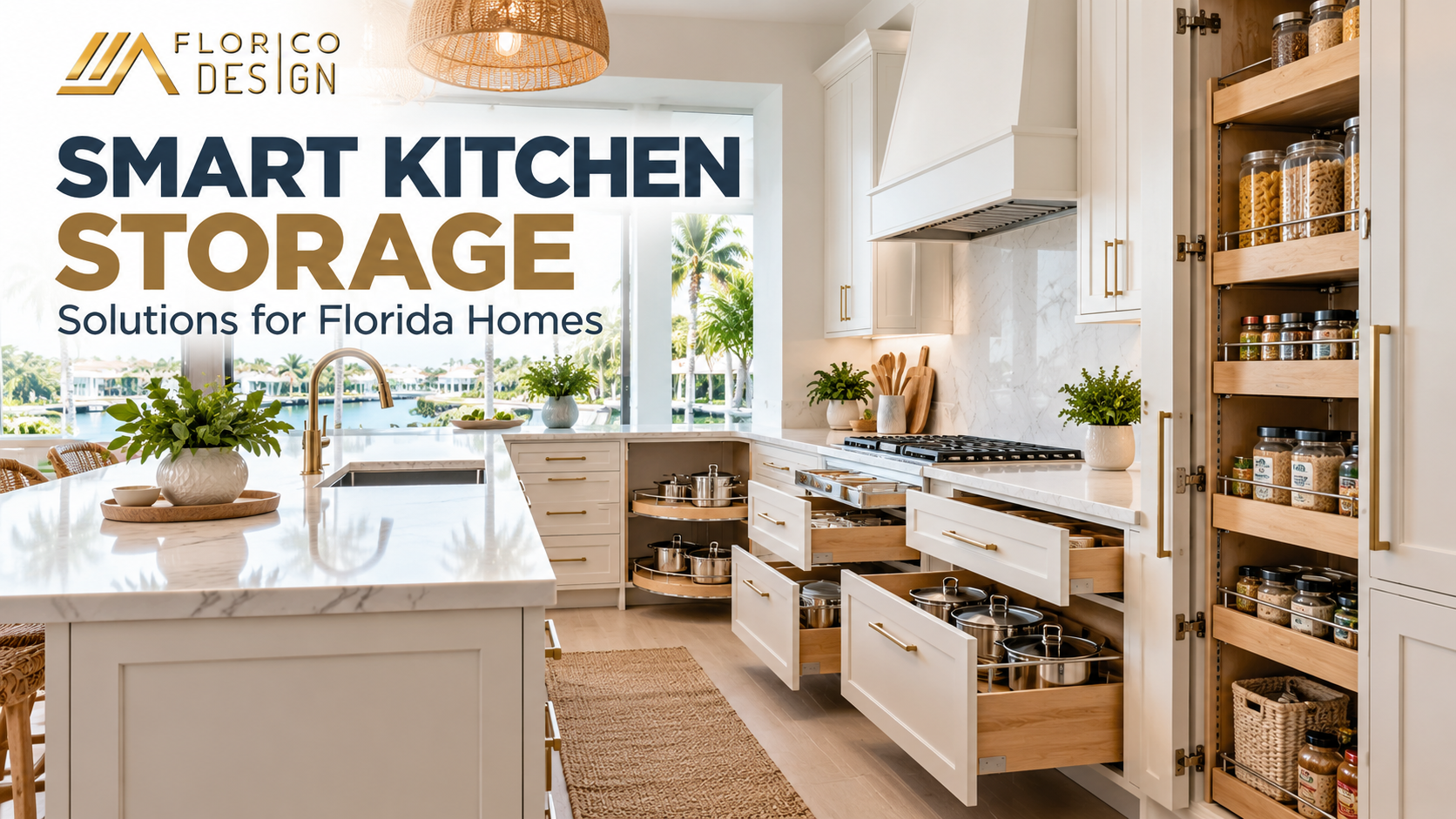
Most kitchens do not run out of cabinets. They run out of the right cabinets in the right places. If you have ever knelt on the floor to find a lid, or stacked pans on top of each other because nothing else fits, you already know the problem.
Storage is the part of a kitchen remodel that people tend to settle last and regret first. Homeowners in Miami, Boca Raton, and Fort Lauderdale spend weeks choosing a door style and a finish, then give storage for ten minutes at the end of the design meeting. This guide flips that order. By the end, you will know which storage types earn their cost, where each one belongs, and how to describe your habits to a designer so the layout is built around them.
Quick answer: which kitchen storage solutions are worth it
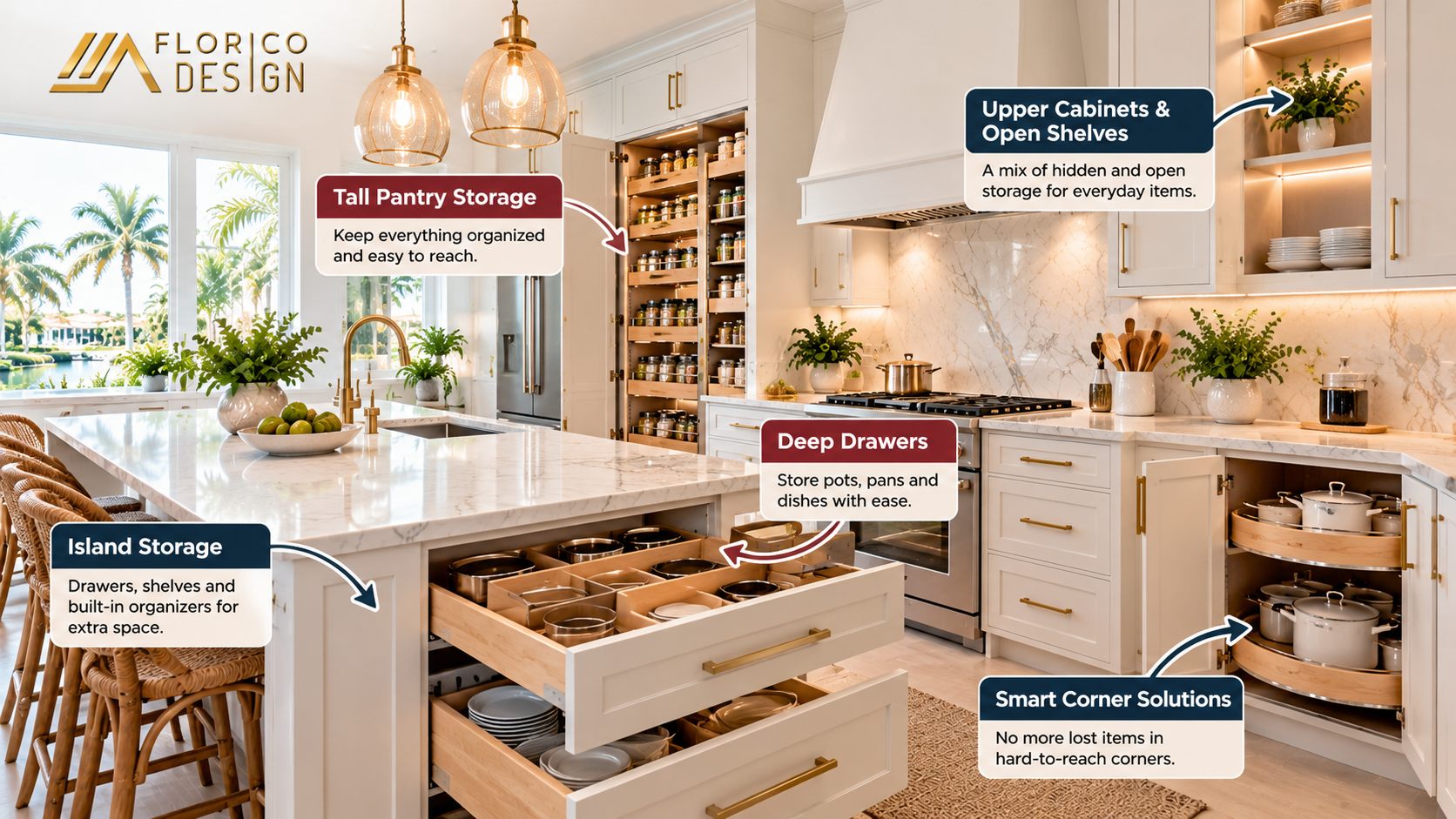
If you only have a budget for a few upgrades, put it here, in this order. Deep drawers in the base cabinets nearest the stove and sink come first, because pots, pans, and dishes are the things you reach for most. A tall pantry cabinet comes second, since it replaces a lot of scattered shelf space with one organized zone. Third is a smart corner solution, so the deepest, hardest-to-reach cabinet in the room stops swallowing things. Interior organizers for utensils, trays and trash come last, and they are often the cheapest way to make existing cabinets feel new.
Start with an inventory, not a catalog
Before looking at a single cabinet photo, walk through your kitchen with a notepad and write down what you own and where it lives today. Pull everything out of one cabinet if you have to. You are looking for three things: what you use daily, what you use weekly, and what you keep for the one dinner party per year.
Daily items should live between knee and shoulder height, close to where you use them. Plates near the dishwasher. Oils, salt, and pans near the stove. Weekly items can sit a bit higher or lower. The once-a-year roasting pan and the holiday platters belong in the least convenient spot you have, and a good layout will give them one on purpose.
This is also the moment to be honest about how you shop and cook. Buying in bulk needs pantry depth. Baking needs a spot for sheet pans stored on their sides. A household that cooks every night needs the prep zone and the cookware zone to sit close together. Whatever your habits are, a designer can only plan for them if you say them out loud.
Drawers or doors: what goes where
The biggest shift in modern kitchen storage is replacing base cabinet doors with drawers. A drawer lets you see everything from above and pull it toward you. A door with a shelf behind it makes you crouch, reach, and move things out of the way to get to what is in back.
Doors still have a place. Tall items, odd-shaped appliances, and cleaning supplies often fit better behind a door. The table below shows how the two compare for common kitchen items.
| Item | Better in a drawer | Better behind a door | Notes |
| Pots and pans | Yes | Sometimes | Deep drawers put lids and cookware in one view |
| Plates and bowls | Yes | Sometimes | Drawers near the dishwasher cut down on carrying |
| Mixing bowls | Sometimes | Yes | Nested bowls work well behind a door with a pull-out shelf |
| Small appliances | No | Yes | Bulky items do better on a shelf or in an appliance zone |
| Cleaning supplies | No | Yes | Keep away from food prep, behind a door near the sink |
| Utensils and gadgets | Yes | No | Shallow drawers with dividers keep them from tangling |
| Trash and recycling | Pull-out | Pull-out | A pull-out inside a base cabinet hides it and saves floor space |
A simple rule that works in most kitchens: if you use it every day and it is smaller than a stockpot, ask whether it can live in a drawer.
Pantry options for Florida kitchens
Pantry storage depends on your floor plan more than any other category. There are three common routes, and each one fits a different kind of home.
Tall pantry cabinet
A full-height cabinet in the kitchen run is the most common choice in newer homes and condos. Pull-out shelves let you see the back of the cabinet without unloading the front. This is a good fit for Miami Beach, Aventura and Sunny Isles Beach condos where there is no room for a separate closet-style pantry.
Walk-in or reach-in pantry
If your home already has a pantry closet, the question becomes whether the shelving inside it works. Many pantries are fitted with a single deep shelf where cans disappear into the back. Custom shelving at different depths solves that. Our custom closet service uses the same approach for pantry closets, since the planning logic is nearly identical.
Pull-out base pantry
A narrow base cabinet with a pull-out rack can hold spices, oils, and cans in a space that would otherwise be dead. It suits galley kitchens and older homes in Coral Gables or Pinecrest where wall space is limited.
Two Florida habits are worth planning for. Many households keep extra water, canned food, and hurricane supplies on hand during storm season, and that stock needs a home that is not the garage. And because humidity is part of daily life here, dry goods such as flour, rice, pasta, and cereal keep better in sealed containers, so shelf spacing should allow for tall storage jars rather than only original boxes.
Corner cabinets that do not swallow things
The corner is where most kitchens lose storage. A standard corner base cabinet is deep, awkward, and usually holds whatever you put in it years ago. There are a few ways to fix that.
- Pull-out corner systems bring the contents to you instead of the other way around. They are the most popular option for L-shaped kitchens.
- A diagonal or angled corner cabinet changes the geometry so the door opens wider and the shelf space is easier to use.
- Blind corner pull-outs work when the corner is truly blind, with the cabinet door opening beside the dead space rather than into it.
- In some layouts, ending the cabinet run with a drawer stack and leaving the corner for an appliance or a decorative piece removes the problem entirely.
Which one works depends on your layout and cabinet construction, so ask your designer to show you the interior of the corner, not just the front. A corner that looks impressive in a render can still be hard to use in daily life.
Island and peninsula storage
An island is not only a place to eat breakfast. Done well, it is the best extra storage zone in the room. The cooking side can hold pots and utensils within a step of the stove. The seating side can hold table linens, serving pieces and anything you want near the dining area but out of the main cabinet run.
Two cautions. First, do not put storage on the seating side if people will sit there with their knees against the cabinet. Second, plan outlets and the sink position before finalizing drawer layouts, because plumbing and electrical can take space you were counting on. The National Kitchen & Bath Association publishes kitchen planning guidelines that many designers use as a reference for clearances and work zones, and it is worth asking your designer how those guidelines shape your island.
Upper cabinets, open shelves and what to skip
Upper cabinets are the best place for lighter, less-used items. Taller uppers that run toward the ceiling give you extra storage for seasonal pieces, though you will need a step stool to use them.
Open shelving looks great in photos, but it works best for items you use often and that look good together. Everything on an open shelf collects kitchen dust and the light film that comes with cooking. If you cook with oil often, think about how much cleaning you are willing to do. Many homeowners end up with one or two open shelves for everyday dishes and keep the rest closed.
Small details that change daily life
- Drawer dividers for knives, flatware, and utensils so nothing slides around.
- A tray or baking sheet divider in a tall, narrow cabinet so pans can stand on their edges.
- A spice drawer or narrow pull-out near the stove instead of a crowded upper shelf.
- An appliance garage or dedicated counter zone for the coffee maker and toaster, so counters stay clear.
- Trash and recycling pull-outs placed near the prep area, not across the room.
- Soft-close hardware, which is worth asking about on every drawer and door.
Matching storage to cabinet construction
Storage features and cabinet construction go together. Some cabinet lines have a fixed list of internal accessories, and others can be built to fit a specific organizer or an odd opening. If you want a layout that goes beyond standard sizes, read our comparison of custom and semi-custom kitchen cabinets to see which route gives you more flexibility inside the box.
If you are still choosing a style, our guide to kitchen cabinet styles for Parkland homeowners can help narrow the look, and you can browse the full kitchen cabinet catalog to see door styles in one place. For ideas beyond cabinets, Houzz is useful for saving photos of storage layouts you like and bringing them to a consultation.
How storage needs change by home type:
Condos in Miami Beach, Sunny Isles Beach and Aventura
Condo kitchens tend to be compact, so vertical storage and drawers matter more. Tall pantry cabinets, shallow uppers that reach the ceiling, and a smart corner solution can add a lot without changing the footprint.
Single-family homes in Pinecrest, Coral Gables and Boca Raton
Larger kitchens often have the opposite problem: lots of cabinets but not enough organization. A zone-based layout, with a baking area, a cooking area, and a cleanup area, makes a big kitchen feel easier to use than one that simply adds more boxes.
Townhomes and newer builds in Doral and Parkland
Builder-grade kitchens in newer communities usually have standard shelving and little internal organization. Replacing doors with drawers in the base cabinets and adding a tall pantry is often the most noticeable upgrade.
What affects the cost of kitchen storage upgrades
Pricing varies from home to home, and we would rather give you factors than a number that may not match your kitchen. The main drivers are the number of drawers versus doors, the type of pull-out hardware, the cabinet construction (stock, semi-custom or custom), the size of the pantry unit, and whether the layout changes require moving plumbing or electrical. Drawers generally cost more than doors because of the hardware. A corner pull-out costs more than a plain shelf for the same reason.
For a broader look at budgets, our Florida kitchen cabinet price guide explains how cabinet tier affects the total, and our post on comparing kitchen remodeling quotes shows how to check that two quotes include the same storage features. If you want to spread the cost, Florico Design also has a financing page.
A step-by-step planning checklist
- List what you use daily, weekly, and rarely, and where each item lives today.
- Mark the items that do not fit anywhere: tall bottles, sheet pans, big pots, small appliances.
- Decide how many drawers you want in the base cabinets near the stove and sink.
- Choose a pantry type that fits your floor plan.
- Pick a corner solution after seeing the cabinet interior, not only the front.
- Think about the island: which side gets storage and which side stays open for seating.
- Ask which organizers are built in and which are add-ons.
- Confirm that every quote includes the same storage features before comparing prices.
What to bring to your design consultation:
Bring photos of your current cabinets, a short list of things that annoy you, and a few pictures of layouts you like. If you can, bring measurements of any tall items that must fit, such as a stand mixer or a large stockpot. A designer can do far more with a list of real problems than with a general wish for more storage.
FAQs:
What is the best storage solution for a small kitchen?
Deep drawers in the base cabinets, a tall pantry cabinet, and a pull-out corner system are usually the best returns in a small kitchen. They use vertical space and corners that stay wasted in a standard layout.
Are drawers better than cabinet doors in a kitchen?
For pots, pans, plates, and utensils, drawers are easier to use because you can see everything from above. Doors work better for tall items, bulky appliances, and cleaning supplies.
How do I add pantry storage without a pantry closet?
A tall pantry cabinet with pull-out shelves in the cabinet run is the most common answer. A narrow pull-out base cabinet can add smaller-scale storage if wall space is limited.
How do I make corner cabinets more useful?
Pull-out corner systems, angled corner cabinets, and blind corner pull-outs all bring the contents toward you. The right choice depends on your layout, so ask to see the interior as well as the front.
Does Florida humidity affect how I should store food in the kitchen?
Dry goods such as flour, rice, and cereal keep better in sealed containers, so plan shelf heights that fit tall storage jars. Ask your designer about cabinet materials and finishes suited to humid conditions, and see our guide to kitchen cabinets in Florida for more on materials.
Can storage upgrades be added without a full kitchen remodel?
In some kitchens, yes. Interior organizers, pull-out trays, and drawer dividers can often be added to existing cabinets. Larger changes, such as replacing doors with drawers or adding a tall pantry, usually involve replacing cabinets. A designer can tell you which category your kitchen falls into.
Final thoughts
Good kitchen storage is mostly a planning exercise. When you know what you own, how you cook and where things should live, the cabinet choices become easier, and the layout feels natural on day one. Skip the temptation to add more boxes, and focus on putting the right storage in the right spots.
Ready to plan a kitchen that fits the way you cook? Schedule a kitchen design consultation with Florico Design, or visit our showroom at 6582 N State Rd 7, Coconut Creek, FL 33073. You can also call +1 954-448-4300 to speak with a kitchen remodeling specialist, or browse our project gallery and completed projects for layout ideas. To get started, contact Florico Design with your measurements and wish list.